
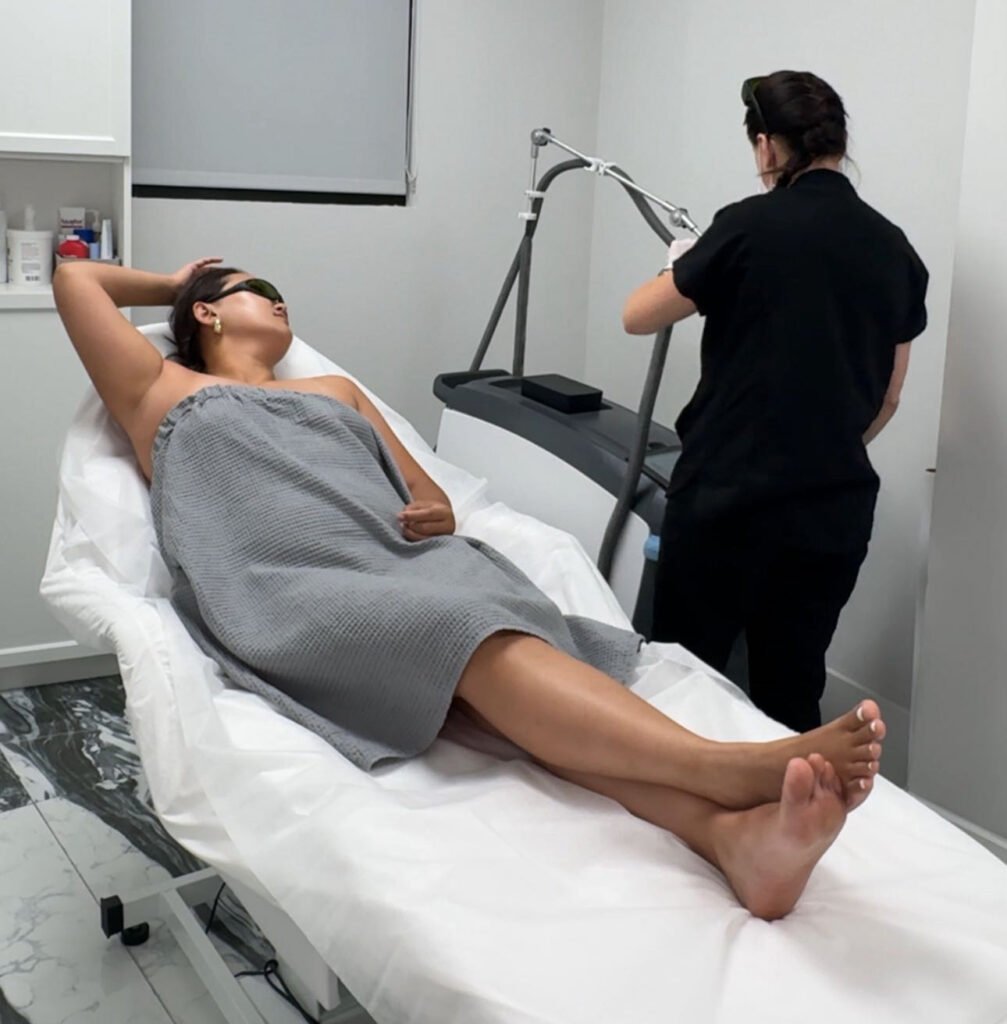
Does it hurt? Well, yes. Sort of.
The honest answer is that you feel it, but for most people it isn’t the kind of pain they imagined when they first hear the word “laser.” There is no heroic suffering required. No clenching your teeth while staring at the ceiling and reconsidering every decision that led you into the treatment room.
The sensation is usually described as a quick snap, pinch, prickling, or tiny rubber-band flick against the skin. Some areas feel warmer than others. Some barely register.
And then it’s over.
Modern laser systems also use cooling to protect the skin and make the treatment more comfortable. At KristinaEpil, treatment settings are adjusted according to your skin tone, hair characteristics, and the area being treated, rather than simply turning the machine up and hoping for the best.
Your first appointment is also the time to find out what your skin thinks about the process. Everybody has a slightly different tolerance.
The Honest Answer
Laser hair removal works by delivering controlled energy into the hair follicle. That energy is absorbed primarily by the pigment in the hair, creating heat that damages the follicle’s ability to produce hair.
You notice the heat. Usually as a brief little sting.
On some areas, it can feel like someone flicked the skin with a very small rubber band. On others, there is more of a warm, prickly sensation that disappears almost as quickly as it arrives.
The upper lip can be surprisingly noticeable because the skin is sensitive and there isn’t much distance between the surface and the underlying structures. Underarms can sting, too. Bikini and Brazilian areas are often more sensitive than legs.
Then there are the legs.
For many people, legs are comparatively easy. Lots of surface area, generally less sensitive skin, and the individual pulses become almost boring after a while. Which is actually good. Boring is excellent during hair removal.
The back, chest, arms, and stomach can vary considerably depending on hair density and individual sensitivity. So when somebody asks, “Is laser hair removal painful?” the accurate answer is: “It depends on the zone and the person.”
And yes, that’s less satisfying than a number from one to ten. It’s also more useful.
Modern Diode Lasers vs. Older Technology
Laser technology has changed quite a bit over the years.
Older systems could be less sophisticated in how they delivered energy and managed heat at the skin’s surface. Modern diode laser systems are designed with more controlled energy delivery and cooling, which can make the treatment considerably more tolerable.
The cooling matters. A lot.
When the skin is cooled around the treatment area, the surface remains more comfortable while the laser delivers energy where it needs to go. The result can feel like a quick burst of heat followed by cooling rather than one continuous hot sensation.
That’s an important distinction. Laser hair removal isn’t supposed to feel like somebody is cooking on your skin. The treatment should be controlled, and the settings should be appropriate for your skin and hair.
At KristinaEpil, the equipment and treatment settings are selected with individual skin tone and hair characteristics in mind. Because two people can walk through the same door needing treatment on the same area and still require different settings.
Skin isn’t a photocopy machine. It doesn’t work that way.
The Zones That Sting More And The Zones That Barely Register
There is a rough pattern, although your personal experience can absolutely ignore the pattern just to keep things interesting.
Upper lip and face: Often more noticeable. Facial skin can be sensitive, and the upper lip in particular can produce a sharp little snap with each pulse.
Underarms: Usually somewhere in the middle-to-more-sensitive range. The sensation is quick, but the area can be reactive.
Bikini and Brazilian: Often among the more sensitive zones. Hair can be dense, the skin is delicate, and individual pulses may feel sharper.
Legs: Frequently one of the easier areas for clients. The sensation may still be noticeable, but many people describe it as manageable.
Arms: Usually moderate and quite tolerable, though the inner arm can be more sensitive.
Back and chest: This depends heavily on hair density. A dense patch can produce more noticeable heat than a sparse area.
And then there’s the strange thing about laser hair removal: the first few pulses can feel like the biggest deal. You know they’re coming. You brace yourself. Then your brain realizes, “Well, that’s it?” After a few minutes, the sensation often becomes much less noticeable because you’re no longer imagining what the next pulse is going to feel like.
The anticipation can be worse than the actual treatment. Classic human behavior.
What You Can Do To Minimize Discomfort: Timing, Cooling, And Numbing
You don’t need to prepare for a laser session like you’re heading into battle. A few simple things can make the appointment easier, though.
First, follow the clinic’s shaving and preparation instructions. We generally recommend shaving about a day before treatment so the laser can target the hair beneath the skin without unnecessary surface hair absorbing energy.
Avoid tanning before treatment, too. Changes in skin pigmentation can affect how laser treatment is performed, which is one reason clinics ask clients to avoid recent tanning.
Then there is cooling. This is one of the biggest comfort factors during modern laser treatment. Cooling can reduce the sensation of heat on the surface while each pulse is delivered.
And timing matters in a more boring way: don’t show up with irritated, freshly sunburned, or otherwise angry skin and expect everything to go perfectly. Your skin has enough complaints already.
What about numbing cream? For some particularly sensitive areas, topical anesthetic may be discussed. Whether it is appropriate depends on the treatment area, the product, your skin, and the clinic’s instructions. Don’t just slather on a random numbing cream before an appointment without asking the professional performing the treatment.
More isn’t automatically better. Especially when you’re dealing with skin and heat.
Finally, tell the specialist what you’re feeling. If the sensation is unexpectedly intense, say so. Treatment settings can sometimes be adjusted according to the individual situation. There is no prize for silently suffering through an appointment if something goes wrong.
Good Omens And Red Flags
During treatment, a brief snapping or pinching sensation is normal. So is warmth. Immediately afterward, the treated area may look a little pink or flushed. You might notice mild swelling around individual follicles, sometimes described as small bumps around the hairs.
That doesn’t necessarily mean something has gone wrong. It’s part of the skin’s immediate response to treatment and often settles relatively quickly.
The treated hairs also don’t necessarily disappear while you’re lying on the treatment bed. This surprises people. Some hairs shed over the following days or weeks as the treated follicles release them. You may also see some regrowth between sessions because laser treatment works most effectively on hairs in particular stages of the growth cycle. That is why one appointment isn’t the whole story.
There are sensations you shouldn’t simply shrug off, though.
Severe or worsening pain, significant blistering, pronounced burns, unusual swelling, or skin changes that seem excessive should be reported to the treatment provider. If you have a concerning reaction after treatment, contact the clinic for guidance rather than trying to diagnose it from a search engine at two in the morning.
Google is very enthusiastic about worst-case scenarios.
The point of a laser appointment isn’t to prove how much discomfort you can tolerate. A properly performed treatment should balance effective energy delivery with appropriate skin protection and comfort. And you don’t really know how the sensation will feel to you until you try it.
That’s why the first appointment matters. At KristinaEpil, your first session includes a patch test so you can experience the process before committing to a full course of treatments. You can ask questions, discuss the areas you want treated, and get a better idea of how your skin responds.
Come in and feel the difference before committing.