
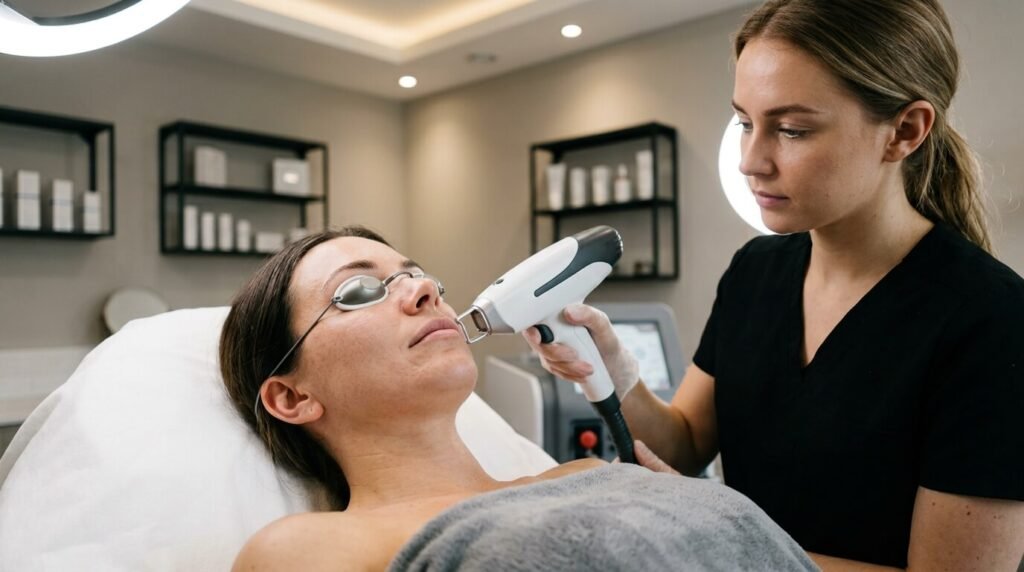
Facial hair is one of the most persistent grooming frustrations there is. Tweeze a chin hair today, and it’s back within days, sometimes growing in at a slightly different angle than before. Thread the upper lip, and the regrowth shows up as stubble within a week or two. Shave, and most people won’t even consider it for the face in the first place. It’s a cycle that never really resolves itself, no matter how consistent the routine.
Laser hair removal approaches the problem differently by targeting the follicle itself rather than the hair growing out of it. This guide walks through how it works specifically on facial hair, what to expect zone by zone, and what makes facial treatment a little different from treating the rest of the body.
How Laser Hair Removal Works on Facial Hair
The underlying mechanism is the same regardless of which part of the body is being treated. A concentrated beam of light is absorbed by melanin, the pigment inside the hair follicle, and converts to heat once absorbed. That heat damages the follicle’s ability to keep producing hair, while the surrounding skin is largely unaffected because the laser is tuned to target that specific pigment.
Facial hair responds to this process the same way hair anywhere else on the body does, but there are a few things that make facial treatment worth understanding on its own terms rather than assuming it’s identical to treating legs or arms.
Why Facial Zones Are Treated Differently Than Body Zones
Facial skin is thinner and generally more sensitive than skin on the arms, legs, or back, which means settings are often more conservative and technique matters more. The face is also home to several distinct zones in close proximity to each other, upper lip, chin, cheeks, sideburns, that can each have different hair density, growth patterns, and sensitivity, which is why a provider treating the face typically works zone by zone rather than treating it as one uniform area.
Facial hair also tends to be more hormonally responsive than hair on many other parts of the body. Conditions like PCOS, certain medications, and natural hormonal shifts can all influence facial hair growth in ways that don’t affect body hair nearly as much, which is part of why facial areas sometimes need a few more sessions or occasional maintenance compared to a more predictable zone like the underarms.
Upper Lip
The upper lip is one of the most commonly requested facial zones, and for good reason: it’s highly visible, the hair tends to be relatively fine but persistent, and traditional removal methods (threading, waxing, depilatory cream) all require frequent repetition to keep up with regrowth.
Sessions on the upper lip are quick, often just a few minutes, since the treatment area is small. Most people need a similar overall session count to other facial zones, generally in the range of six to ten sessions, though upper lip hair can sometimes respond a little more slowly than coarser hair elsewhere on the face, simply because finer hair carries less melanin for the laser to target. The upper lip treatment page covers what a typical course looks like for this specific zone in more detail.
Chin
Chin hair tends to be coarser and more deeply rooted than upper lip hair, which often means it responds a bit more readily to treatment, since coarse, dark hair carries more melanin for the laser to lock onto.
The chin is also one of the zones most likely to be affected by hormonal factors, which is worth knowing going in. If chin hair growth has been an ongoing frustration despite regular removal, it’s worth mentioning any relevant hormonal history during a consultation, since a provider can factor that into a realistic session estimate rather than promising a standard timeline that might not account for it. The chin-specific treatment page walks through session expectations for this zone.
Cheeks and Sideburns
Cheek and sideburn hair is often finer and less dense than chin or upper lip hair, and treatment here tends to be about precision as much as anything else. Because these zones border other facial areas closely, a provider needs to work carefully to keep the treatment boundary clean and even, rather than leaving a visible line between treated and untreated skin. This is one of the clearer examples of why facial treatment benefits from an experienced hand, since the technical execution matters as much as the equipment itself.
Sensations and Comfort
Most people describe facial laser treatment as similar to a rubber band snapping lightly against the skin, uncomfortable in the moment but far from unbearable, and it varies somewhat depending on your personal pain tolerance and which zone is being treated. The upper lip and areas close to the nose tend to register a bit more than the cheeks or jawline, simply because skin sensitivity varies across the face. Most modern devices include a cooling mechanism built into the handpiece that meaningfully reduces discomfort compared to older laser systems, and sessions are quick enough on facial zones that any discomfort is over within minutes.
How Many Sessions to Expect
Most facial zones require somewhere in the range of six to ten sessions, spaced four to eight weeks apart, to see substantial results. The reasoning is the same as anywhere else on the body: hair grows in cycles, and laser can only affect follicles that are actively growing at the time of treatment, so spacing sessions out allows each subsequent visit to catch hair that’s since entered its active growth phase.
Facial zones sometimes land at the higher end of that range compared to areas like the legs or underarms, partly because hormonal influence on facial hair can trigger new growth more persistently, and partly because finer hair in areas like the upper lip carries less pigment for the laser to target efficiently. This isn’t a sign that anything is going wrong, it’s simply how facial hair tends to behave, and a good provider will set that expectation clearly from the start rather than promising a faster timeline than is realistic.
What Kind of Hair Responds Best
Dark, coarse facial hair responds most readily to laser treatment, since it carries the most melanin for the laser to target precisely. Fine, light-colored facial hair, common on the upper lip and cheeks for some people, can take a bit longer to show dramatic results, though meaningful reduction is still achievable with a full course.
Very light hair, blonde, gray, white, or red, doesn’t respond well to laser treatment on the face any more than it does elsewhere on the body, since there simply isn’t enough pigment in the follicle for the laser to lock onto. If that describes your facial hair, it’s worth discussing electrolysis as an alternative during a consultation, since it works by treating each follicle individually and doesn’t depend on hair color the way laser does.
Skin tone matters here too, and it’s worth being direct about it: older laser technology genuinely struggled with darker skin tones, which is where a lot of outdated hesitation about facial laser treatment comes from. Modern longer-wavelength systems, most commonly Nd:YAG lasers, are specifically designed to treat medium to deep skin tones safely and effectively, which has changed what’s realistically possible for a much wider range of people than was true a couple of decades ago. What matters is confirming a provider actually has the right equipment and experience for your specific skin tone, not assuming facial laser is or isn’t an option based on outdated information.
Redness, Swelling, and the Realistic Post-Session Timeline
Facial skin tends to show visible reaction a bit more readily than body skin, simply because it’s thinner and more exposed to view day to day. Mild redness and slight swelling immediately after treatment are completely normal and generally resemble a light sunburn reaction. Most of this settles within a few hours, though some people notice slightly more visible redness on the face than they would on, say, the legs, purely because facial skin is more sensitive and more visible in a mirror.
A few practical notes for facial treatment specifically: it’s worth planning sessions with a little buffer before any event where you’d rather not show up with visible redness, since same-day makeup application is generally discouraged for at least a few hours after treatment to avoid irritating freshly treated skin. Sun protection is a particularly high priority for facial zones, both because the face gets more consistent daily sun exposure than most body areas and because treated skin is more sensitive to UV in the days following a session. A broad-spectrum sunscreen used consistently on the face already makes sense as a general habit, and it becomes even more important during a laser hair removal course.
Preparing for a Facial Session
Preparation for facial zones follows the same core principles as anywhere else on the body, with a few facial-specific notes worth highlighting.
Shave the treatment area the day or night before your appointment rather than using any method that removes hair from the root. Avoid sun exposure and self-tanner for at least two to four weeks beforehand, since tanned skin increases the risk of an adverse reaction and reduces treatment effectiveness. Skip other facial hair removal methods, threading, waxing, plucking, depilatory cream, entirely in the weeks leading up to treatment, since all of them disturb the very follicle the laser needs intact to work.
Arrive with a clean face, free of makeup, moisturizer, or sunscreen on the areas being treated. If you use retinol, glycolic acid, or other active skincare ingredients regularly, pause them on the treatment area for about a week before and after each session, since these can increase skin sensitivity right when it’s already elevated from treatment. And if you have a history of cold sores, mention it during your consultation before facial treatment specifically, since certain facial procedures can occasionally trigger an outbreak in people prone to them, and a provider can take precautions in advance if they know to expect it.
Choosing a Provider for Facial Treatment
Facial zones reward a provider’s experience and precision more than some other areas of the body simply because of how many distinct zones are packed closely together and how visible any inconsistency in results would be. A good consultation should include a specific assessment of your facial hair pattern, skin tone, and any relevant hormonal history, along with a realistic session estimate for each zone you’re considering rather than a single blanket number for “the face” as though every zone behaves identically.
It’s also worth asking directly what laser system a provider uses and whether it’s appropriate for your specific skin tone, particularly if you have a medium to deep complexion, since this is exactly the kind of detail that separates a provider who’s genuinely equipped to treat your face safely from one who’s applying a one-size-fits-all approach. A closer look at how skin tone affects laser treatment more broadly is useful background before any facial consultation, since the same principles that apply to body treatment apply here, just with less room for error given how visible the results are.
The Bottom Line
Facial hair is one of the more persistent grooming challenges precisely because most traditional removal methods only ever address what’s already grown in, leaving the follicle fully intact and ready to produce the next round of regrowth within days. Laser hair removal breaks that cycle by targeting the follicle directly, and while facial zones come with their own considerations, hormonal sensitivity, finer hair in some areas, and the visibility factor that makes precision matter, a properly trained provider working with the right equipment can deliver results that hold up far longer than any at-home routine ever could.
Understanding what to expect zone by zone, and choosing a provider who treats each area with the attention it actually requires, is what separates a facial laser hair removal course that delivers real, lasting results from one that leaves you disappointed by session six.