
Every autumn, the same pattern repeats. Long sleeves come out, legs disappear under jeans and tights, and the daily grooming routine that felt urgent all summer quietly relaxes. It’s an easy season to stop thinking about hair removal entirely.
It’s also, somewhat counterintuitively, the single best time to start a laser hair removal course. The reasoning has nothing to do with marketing and everything to do with how the treatment actually works, how long a full course takes, and what your skin needs in order to respond safely. Here’s the case for starting now rather than waiting for spring.
Why Timing Actually Matters for This Treatment
Unlike a lot of cosmetic treatments, laser hair removal isn’t something you can decide to do on short notice and see through to a finished result. It requires multiple sessions spaced weeks apart, and the number of sessions and the spacing between them are dictated by biology, not convenience.
Hair grows in three distinct phases: anagen, the active growth phase where the follicle is supplied with blood and nutrients; catagen, a short transitional phase; and telogen, a resting phase where the hair is no longer growing but hasn’t shed yet. Laser hair removal only works on hair that’s in the anagen phase, since that’s when the follicle is active and vulnerable to the heat the laser generates. At any given time, only a portion of the hair in a treatment area is in that active phase, which is exactly why a single session can’t catch everything and why a full course typically requires six to ten sessions spaced four to eight weeks apart.
That timeline means a course started in early fall can realistically wrap up well before beach season arrives the following year. A course started in late spring, by contrast, is still in progress when summer actually shows up, which puts you in the frustrating position of dealing with partial results exactly when you wanted the treatment finished.
The Skin Reason Fall and Winter Work Better
There’s a second, more practical reason cooler months make sense, and it has to do with what the laser needs from your skin to work safely.
Laser hair removal targets melanin, the pigment found in hair follicles, using contrast between the hair’s pigment and the surrounding skin to zero in on the follicle precisely. Tanned or sun-exposed skin carries more melanin at the surface than it normally would, which reduces that contrast and makes treatment both less effective and less safe. A tan increases the risk of an adverse skin reaction during treatment, which is exactly why reputable providers ask clients to avoid sun exposure and tanning beds for several weeks before every session, not just the first one.
Fall and winter solve this problem naturally. Skin tends to be at its least tanned during these months, clothing covers treatment areas more of the time by default, and the temptation to spend hours outdoors in direct sun is lower. That combination makes it considerably easier to keep skin in the right condition for consistent, safe treatment across an entire course, compared to trying to protect treated skin through a summer full of beach days and outdoor plans.
Working Backward From Next Summer
If the goal is smooth, treated skin by the time warm weather returns, it helps to actually map out a realistic calendar rather than starting sessions and hoping for the best.
Counting backward from a summer deadline, and accounting for six to ten sessions spaced four to eight weeks apart, a full course generally takes somewhere between six months and a year from first session to completion. Starting in fall gives that timeline plenty of room to finish before summer arrives, with buffer left over for the occasional rescheduled appointment or a slower-than-expected response in a particular area.
Starting in late spring or early summer instead compresses that same timeline into a season that isn’t well-suited to it in the first place, both because of the sun exposure issue and because there’s simply less calendar room left before the deadline people are usually working toward. It’s not that starting later doesn’t work at all, results still build with each session regardless of when you start, but the timeline stops lining up with what most people actually want, which is finished results by the time they need them.
What Actually Happens During Treatment
Knowing what a session involves makes the whole process feel considerably less mysterious, whether you start in October or June.
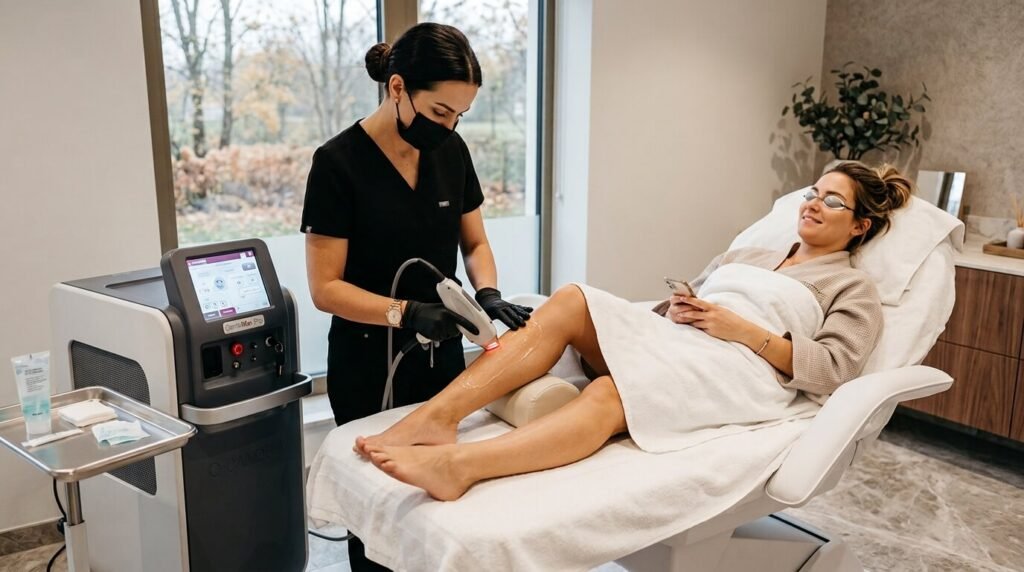
A laser device delivers pulses of concentrated light to the treatment area. That light is absorbed by melanin in the hair follicle, converts to heat, and damages the follicle enough to disrupt its ability to keep producing hair. Most people describe the sensation as similar to a rubber band snapping lightly against the skin, more of a quick warm pinch than sharp pain, and most modern devices include a cooling mechanism that makes the experience considerably more comfortable than older equipment from years past.
Session length depends heavily on the treatment area. Smaller zones like the upper lip or underarms are often finished in a matter of minutes, while larger areas like the full legs or back can take closer to an hour. It typically takes two to three weeks after a session before you notice a visible difference, as the treated hairs shed gradually rather than falling out immediately.
Who Tends to See the Strongest Results
Laser hair removal isn’t equally effective for everyone, and it’s worth understanding where you fall before committing to a full course.
The strongest, fastest results come from dark, coarse hair, since that hair type carries the most melanin for the laser to target precisely. Very light hair, blonde, gray, white, or red, doesn’t respond well to laser treatment on any skin tone, since there simply isn’t enough pigment in the follicle for the laser to lock onto. If that describes your hair, it’s worth having an honest conversation with a provider about whether laser is the right method for you or whether an alternative like electrolysis would serve you better.
Skin tone also plays a role, though modern equipment has changed this significantly compared to older laser technology. Longer-wavelength systems, most commonly Nd:YAG lasers, are specifically designed to treat medium to deep skin tones safely and effectively by penetrating more deeply while being absorbed less by melanin at the skin’s surface. What matters most is whether a given provider has the right equipment and the training to use it correctly for your specific skin tone, which is exactly the kind of thing worth asking about directly during a consultation rather than assuming based on the clinic’s general reputation.
Is It Actually Permanent?
This deserves a precise answer rather than a marketing-friendly one. Laser hair removal delivers a substantial, long-lasting reduction in hair growth for most people, not an absolute guarantee that every single hair is gone forever.
In practice, that distinction matters less than it sounds. Most hair that’s properly treated across a full course doesn’t grow back, and what does return tends to be noticeably finer and lighter than before. Occasional maintenance sessions, typically once or twice a year, are common even after a completed course, since hormonal changes and natural aging can occasionally reactivate a follicle that had gone dormant. That’s a very different picture from shaving or waxing, both of which require ongoing upkeep on a schedule of days or weeks rather than months or years.
Preparing for Your First Session
A little preparation goes a long way toward both comfort and results, and it applies whether your first session lands in October or April.
Before your appointment:
- Shave the treatment area the day or night before, since the laser needs the hair root intact under the skin rather than hair growing above the surface.
- Avoid sun exposure, tanning beds, and self-tanner in the treatment area for at least two to four weeks beforehand.
- Skip waxing, plucking, sugaring, threading, or hair removal cream in the weeks leading up to your session, since all of these remove hair from the root, exactly what the laser needs intact to work effectively.
- Arrive with clean skin, free of lotions, makeup, or oils on the areas being treated.
- Ask about a patch test if you haven’t had laser hair removal with this provider before, since a small test area confirms the settings are right for your skin before committing to a full session.
In the days after:
- Avoid hot showers, saunas, and intense exercise for about 24 hours, since heat and sweating can irritate freshly treated skin.
- Skip retinol, glycolic acid, salicylic acid, and physical exfoliants on the treated area for roughly a week before and after each session.
- Apply broad-spectrum sunscreen if the treated area will be exposed to any sun at all, since skin is more sensitive to UV exposure immediately following treatment.
- If regrowth needs managing between sessions, shaving is the only method that won’t interfere with your progress; waxing or plucking undoes the very thing the laser is working to disrupt.
Choosing a Provider Worth Trusting
Not every clinic offering laser hair removal is operating at the same standard, and the cooler months, when you have time to research before committing to a course, are a good window to be selective rather than rushing into whichever option is cheapest or closest.
A properly trained provider will assess your specific skin tone, hair color, and treatment area before recommending anything, rather than offering a generic package regardless of who walks in. They’ll be able to explain what laser system they’re using and why it fits your profile, they’ll take a patch test seriously rather than treating it as an unnecessary step, and they’ll give you a realistic session estimate rather than a suspiciously low number designed to make the treatment sound faster than it actually is. A closer look at what separates laser from IPL and electrolysis is worth reading before your consultation, since understanding the differences between these methods makes it much easier to ask the right questions and recognize a provider who genuinely knows what they’re talking about.
The Bottom Line
Starting a laser hair removal course in fall or winter isn’t just a seasonal marketing angle, it’s the timeline that actually lines up with how the treatment works. Skin tends to be in better condition for safe treatment during these months, the multi-session timeline has room to finish well before summer arrives, and there’s no need to work around beach trips, tans, or the sun exposure that makes treatment less effective and more risky.
If you’ve been putting off starting because summer feels far away, that’s actually the best possible reason to begin now. By the time flip-flops and shorts come back out, you could be looking at a finished course rather than one that’s only just getting started. For a broader sense of how laser measures up against the shaving and waxing routine most people are used to, this comparison of the real time and effort involved in each method lays out exactly what’s actually being traded off when you start a course this time of year.