
For a long time, one piece of advice circulated widely among people with darker skin tones: stay away from laser hair removal. It wasn’t bad advice at the time. It was accurate advice about outdated technology that has since been replaced.
That gap between what used to be true and what’s actually true today is exactly where a lot of hesitation still lives. This article looks at where the original concern came from, what changed, and what actually determines whether laser hair removal is safe and effective for melanin-rich skin.
Where the Caution Came From
Laser hair removal saw its first real boom in the 1990s, and the technology from that era genuinely did carry more risk for darker skin tones. Understanding why requires understanding how the treatment works in the first place.
Laser hair removal targets melanin, the pigment found in hair follicles. A concentrated beam of light is absorbed by that pigment, converts to heat, and damages the follicle’s ability to keep producing hair. The process depends on contrast: the laser needs to be able to tell the difference between the pigment in the hair and the pigment in the surrounding skin.
Early laser systems worked well when hair was noticeably darker than the surrounding skin, which made them a natural fit for light skin with dark hair. But when the skin itself carried significant melanin, the laser had a much harder time distinguishing hair from skin. Instead of targeting the follicle precisely, it risked being absorbed by the skin itself, which raised the real possibility of burns, blistering, and lasting changes in pigmentation. That risk wasn’t a myth or an exaggeration. It was a genuine limitation of the equipment available at the time, and it’s exactly why the caution took hold and spread.
What Actually Changed
The shift didn’t come from a single breakthrough so much as the development of laser systems built specifically around a longer wavelength.
Nd:YAG lasers operate at a wavelength significantly longer than the diode and Alexandrite systems that dominated earlier laser hair removal. That longer wavelength penetrates more deeply into the skin while being absorbed less by melanin near the surface. In practical terms, it can reach the follicle with far less risk of also heating the surrounding skin, which is precisely the property that makes it suitable for medium to deep skin tones.
This is a genuine technological shift, not a marketing rebrand of the same old equipment. Clinics that have invested in Nd:YAG systems, and that train their staff to use them correctly, can now treat a far wider range of skin tones safely than was possible a couple of decades ago. The caution that used to be broadly true of the whole category now only applies to providers still relying on equipment or settings that were never designed for darker skin in the first place.
Why the Provider Matters More Than the Technology Alone
Here’s the part that gets left out of a lot of conversations about this topic: owning an Nd:YAG laser doesn’t automatically mean a provider knows how to use it well.
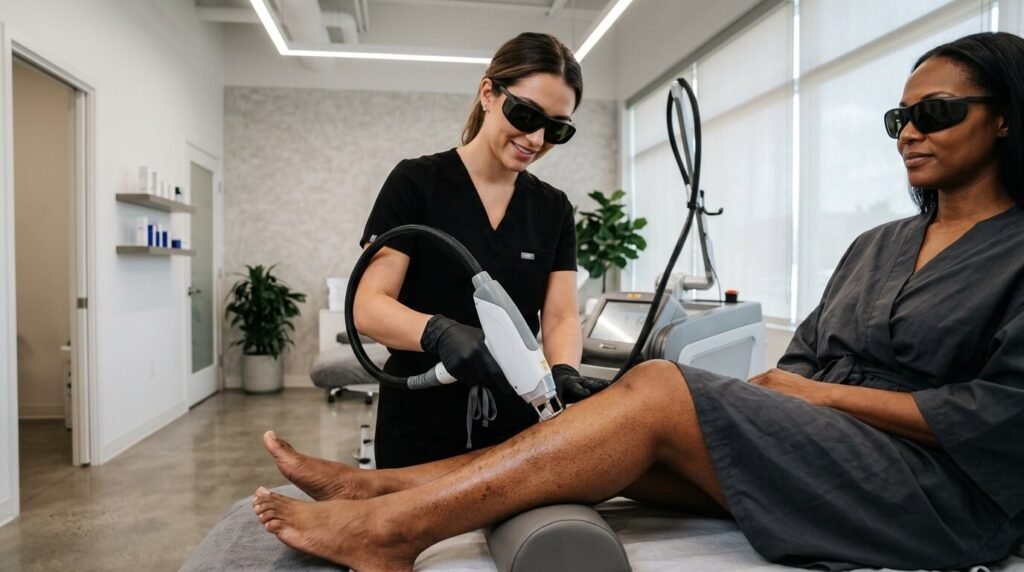
Treating darker skin tones safely and effectively requires a genuine assessment, not a one-size-fits-all setting applied to everyone who walks in. A properly trained provider adjusts fluence (the energy delivered per pulse), pulse duration, and cooling settings based on an individual’s specific skin tone, not just a broad category. Skin tone exists on a spectrum, and two people who’d both be described as having “dark skin” can still need meaningfully different settings from each other.
This is also where the industry’s blind spots show up most clearly. A provider who has mostly worked with lighter skin tones, or who was trained primarily on a laser system not well-suited to deeper skin, may default to overly conservative settings out of caution, which means slower results and more sessions than necessary. In a worse scenario, an inexperienced or poorly trained operator might not adjust settings enough, which is where the real risk of burns or pigment changes still exists today, not because the technology can’t handle it, but because the person operating it wasn’t equipped to use it correctly for that skin tone.
This is precisely why a patch test matters more for darker skin tones than it does for lighter ones. A small test area, treated and observed before committing to a full session, gives both the client and the provider a chance to confirm the settings are right before treating a larger area. A clinic that skips this step, or treats it as an inconvenience rather than a standard precaution, is worth being cautious about.
What to Ask Before You Book
A few direct questions during a consultation go a long way toward understanding whether a provider genuinely has the experience to treat your skin tone well.
Ask specifically what laser system the clinic uses, and whether it’s Nd:YAG or a system otherwise validated for deeper skin tones. Ask how the technician determines the right settings for your specific skin, and whether that assessment happens for every client individually rather than by a fixed protocol. Ask whether a patch test is standard practice before a full first session. And ask how many clients with your skin tone the provider has treated, since real experience with a range of skin tones is different from technical familiarity with a device in theory.
A provider who answers these questions specifically and confidently is demonstrating real expertise. Vague answers, or an assumption that all darker skin can be treated the same way, are signs worth taking seriously before committing to a full course of sessions.
Setting Realistic Expectations
Laser hair removal on darker skin tones can absolutely achieve strong, lasting results with the right equipment and provider, but a few things are worth knowing going in.
Session counts sometimes run a little higher, often in the range of eight to ten sessions rather than six to eight, since providers working with darker skin tones often use more conservative settings initially to confirm how the skin responds before increasing intensity. This isn’t a sign that the treatment is less effective. It’s a deliberate, safety-first approach that pays off in a cleaner result with fewer complications.
Hair color still matters just as much as skin tone. Dark, coarse hair responds well regardless of skin tone, since the laser is still targeting pigment in the follicle specifically. Very light, blonde, gray, or white hair remains difficult to treat with laser on any skin tone, since there simply isn’t enough pigment for the laser to target. That limitation isn’t specific to darker skin tones at all, it’s a limitation of light-based hair removal generally.
The Representation Gap Worth Naming
Part of why hesitation persists has less to do with the technology and more to do with how the industry presents itself. Marketing materials, before-and-after galleries, and treatment photos have historically skewed heavily toward lighter skin tones, which understandably leaves people with darker skin wondering whether a given clinic actually has real experience treating skin like theirs, or whether they’d be the clinic’s first attempt.
That’s a fair question to ask directly, rather than trying to infer an answer from a website. A clinic confident in its experience with a range of skin tones should be able to speak to that experience specifically and, ideally, show real examples reflecting that range, not just reassure vaguely that “we treat everyone.”
The Bottom Line
The old advice to avoid laser hair removal on darker skin tones was accurate advice for a piece of technology that’s mostly been replaced. Modern Nd:YAG systems, in the hands of a provider trained specifically to work with a range of skin tones, have made laser hair removal a safe and effective option for melanin-rich skin, not a lesser or riskier version of the same treatment.
What hasn’t changed is that the provider matters as much as the equipment, sometimes more. The right questions during a consultation, a patch test before committing to a full session, and a provider who can speak specifically to their experience with your skin tone are what actually separate a safe, effective outcome from the outdated risks that gave laser hair removal its reputation in the first place. For a broader look at how laser stacks up against other hair reduction methods across skin tones and hair types, this comparison of laser, IPL, and electrolysis is a useful next read, and the underarm treatment overview walks through what a typical session and course actually look like in practice.